


🔬 API blend filling with OptiFiller on RoTab® R&D tablet press series – what really happens inside the feed-frame?
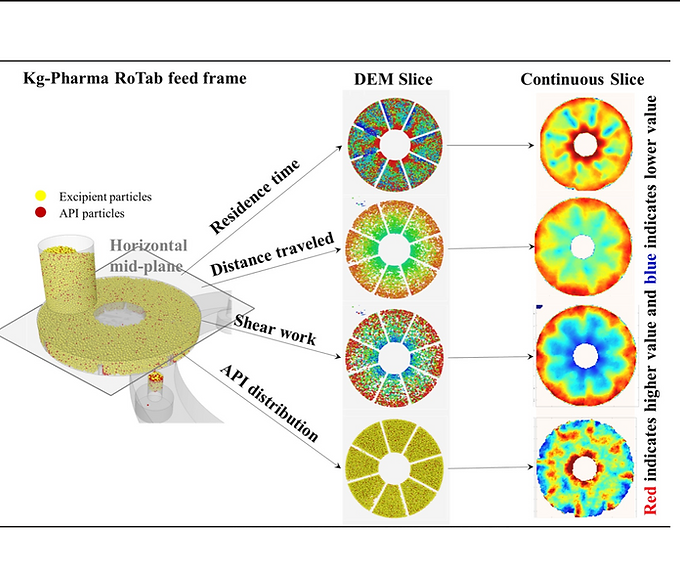
From a study conducted by Alkermes, Waltham, MA, USA (2022) at the University of Texas at...
Austin👇
We often talk about output, speed, and efficiency…
But what about what’s happening at the particle level during API blend feeding?
⚙️ Speed isn’t just productivity — it’s quality control
• 🔄 Turret speed dominates tablet mass & variability
Higher speed → lower mass + higher variability
• 🌀 Paddle speed drives particle stress
Higher speed → more shear → higher risk of over-lubrication & attrition
• ⏱️ Residence time is the hidden lever
Too long → over-lubrication
Too short → poor mixing & content variability
💡 The insight?
API blend filling is not just a feeding step…
It defines content uniformity, segregation behavior, and final tablet quality.
⚖️ The real challenge is balance:
Enough mixing
Minimal segregation
Controlled shear
Consistent die filling
🚀 And this is exactly where simulation (DEM - Discrete Element Method) changes the game:
We can finally see what was previously invisible.
🙏 Special thanks to the authors from Alkermes for this insightful work and for advancing particle-level understanding in pharmaceutical manufacturing.
👉 So here’s the question:
Are you optimizing your API feeding…
or truly understanding it?
Hashtag#Pharma Hashtag#Tableting Hashtag#ProcessEngineering Hashtag#API Hashtag#ContinuousManufacturing Hashtag#Simulation Hashtag#DEM Hashtag#PharmaceuticalDevelopment
